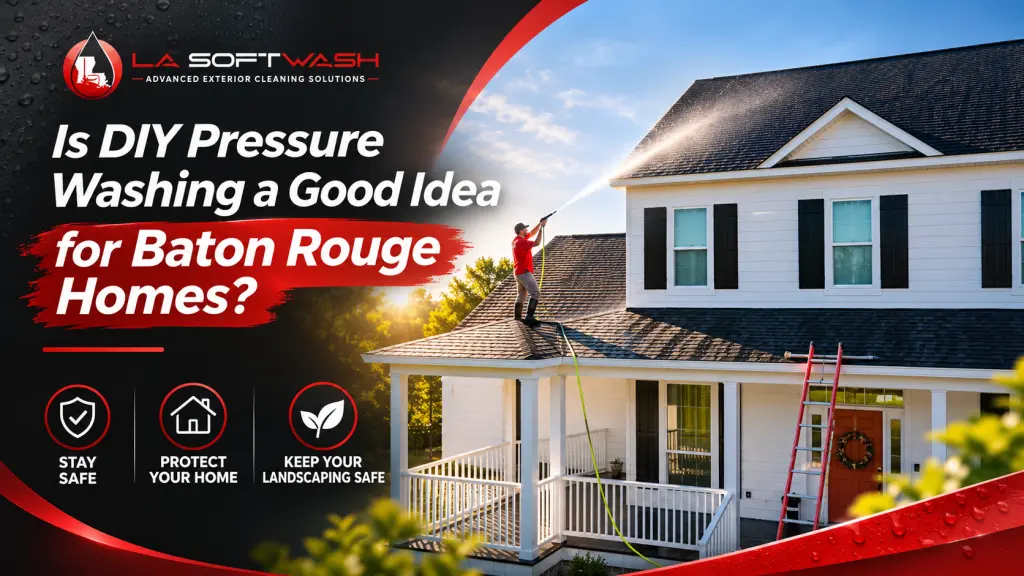


Renting a pressure washer makes sense for a small concrete patio or walkway at ground level, but siding, stucco, roofs, new concrete, and anything above the first floor are where Baton Rouge homeowners cause damage or get hurt. High pressure also strips mildew off without killing it, so it grows back fast.
Green streaks on the shady side of the house and a driveway gone gray make renting a pressure washer for the weekend look tempting. How hard can it be?
The honest answer depends on what you point it at. Some jobs are perfectly reasonable for a homeowner, while a mistake on others costs more to repair than hiring out would have. Many people also try to soft wash by turning a pressure washer down, but real soft washing relies on a cleaning solution applied at low pressure, which is why we run a dedicated, commercial-grade soft wash system. Below is our breakdown by surface, cost, and safety.
Which Jobs Can You DIY? A Surface-by-Surface Verdict for Baton Rouge Homes
Hard concrete at ground level that’s at least a few years old is the safest place to start. Painted siding, stucco, wood, roofs, anything elevated, and brand-new concrete are where rental machines cause the most damage.
Most homes we wash around Baton Rouge have vinyl, Hardie board, brick, or stucco, with a lot of stucco in the mix, so the house itself usually gets a “Hire a pro” verdict.
Swipe to view full table →
| Surface | DIY Verdict | Why | How We Handle It |
|---|---|---|---|
| Concrete patio or walkway (3+ years old) | Good DIY job | Forgiving if you keep the wand moving | Soft wash pre-treatment, pressure wash, rinse |
| Driveway (3+ years old) | DIY with caution | Hand wands leave stripes and can etch | Same process, plus degreaser on oil spots |
| New concrete (under 3 years) | Skip the pressure | Young concrete’s top layer wears away easily | Soft wash only |
| Vinyl siding | Hire a pro | Can crack panels and push water behind them | Low-pressure soft wash, soffit to ground |
| Hardie board | Hire a pro | Can lift paint and force water into seams | Same soft wash process |
| Stucco | Hire a pro | Porous finish etches and soaks up water | Same soft wash process |
| Brick | Possible with care | Mortar joints can erode under pressure | Soft wash |
| Asphalt shingle roof | Never | Manufacturers say not to power wash shingles | Soft wash at low pump pressure |
| Metal roof | Never | Slippery, high-risk, easy to damage the finish | Soap additive that helps protect the metal |
| Treated wood deck or fence | Use low pressure | Too much pressure splinters and gouges wood | Bleach soft wash, oxalic acid to neutralize and brighten |
| Windows and screens | No high pressure | Can break seals and tear screens | Water-fed pole with purified water |
| Anything above the first floor | Hire a pro | Ladder plus pressure wand invites a fall | Low-pressure soft wash, lifts or ladders as needed |
Siding and Stucco Are Where Most DIY Damage Happens
A pressure washer aimed upward at vinyl drives water behind the overlapping panels. On Hardie board, it can lift paint. On stucco, a narrow tip etches the finish and pushes water into hairline cracks. Because that damage rarely shows up the day you wash, many homeowners don’t find it until a repair is needed.
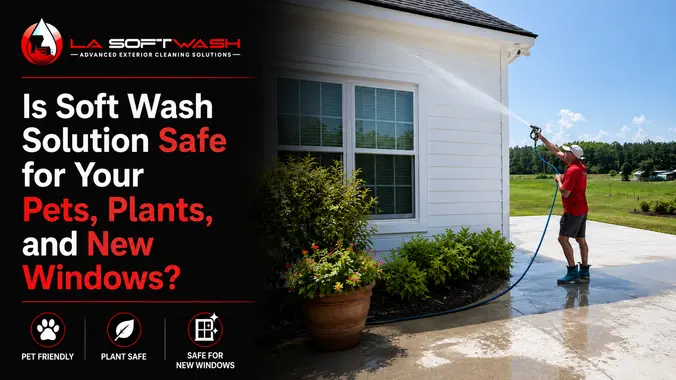
Our house wash covers everything below the shingle line: soffit, fascia, walls, windows, porches, and patios. The cleaning solution does the work at low pressure, so nothing forces water where it shouldn’t go. If your siding is overdue, a low-pressure house wash is a safer bet than a rental wand.
Never Point a Pressure Washer at Your Roof
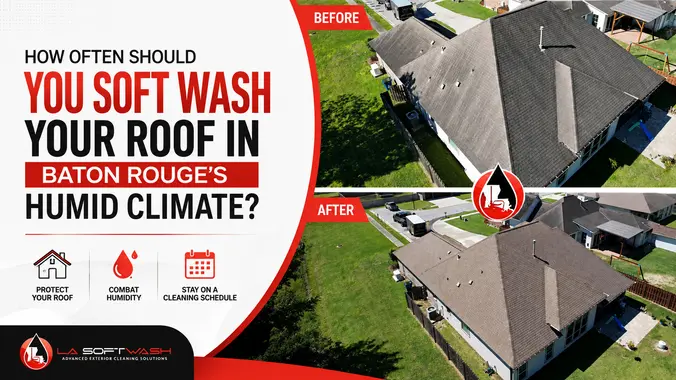
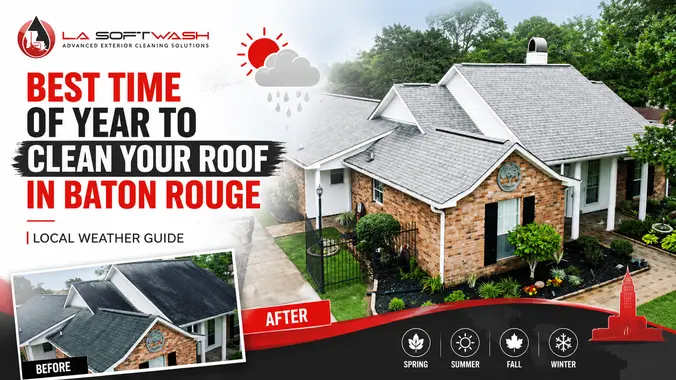
The Asphalt Roofing Manufacturers Association (ARMA) leaves no room for interpretation. Its guidance on roof algae says not to use a power washer on asphalt roofs because high pressure is likely to damage them. ARMA also notes that algae staining is most widespread in the Gulf States, and because cleaning makes a roof slippery, it encourages homeowners to use professionals.
We set our soft wash pump to about 150 to 200 PSI, and by the time the spray reaches the shingles, the pressure is almost nothing. Our roof soft washing service comes with a three-year warranty.
Why DIY Pressure Washing Doesn’t Last in Baton Rouge’s Humidity
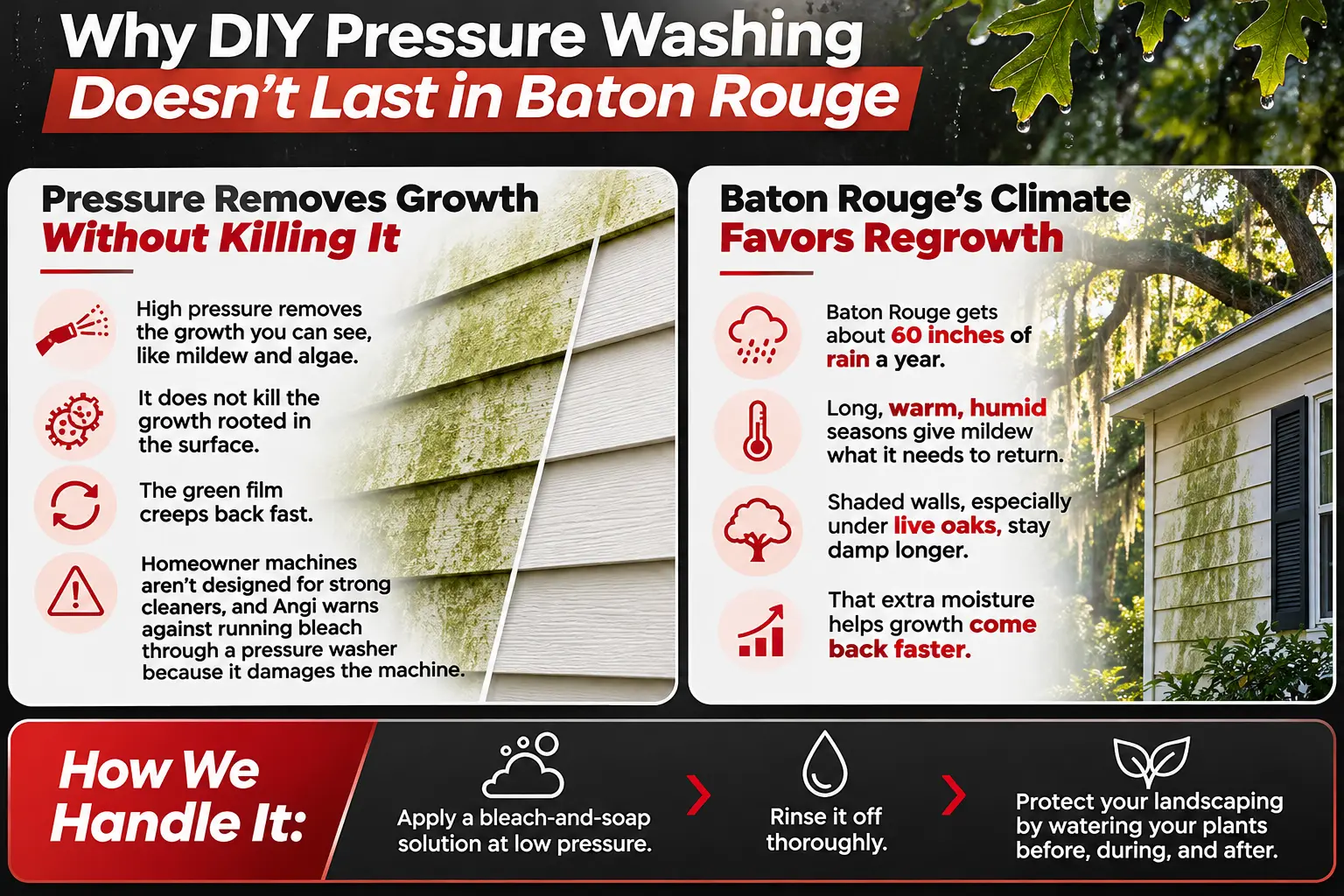
Our guide to the difference between pressure washing and soft washing covers the mechanics in more detail.
What DIY Pressure Washing Really Costs Compared to Hiring Us
A rental looks cheap at the counter, but the rental fee is only part of the cost. Once you add supplies, your time, and the chance of damage, the gap between DIY and hiring out is often smaller than it looks.
Rental Costs vs. Our Rates
Renting a pressure washer averages $90 a day, according to Angi, with prices ranging from $50 to $250 depending on the machine. On top of the rental, you’ll pay for detergent, gas, and any attachments, and you’ll spend a half day to a full day on the job. Compare that with our rates:
| Example Job | DIY Route | Hiring Us |
|---|---|---|
| Driveway | $50 to $250 rental day (about $90 on average), plus supplies and 2 to 4 hours | 10 to 18 cents per sq ft |
| 2,000 sq ft single-story house | $50 to $250 rental day, plus cleaner, ladder work, and most of a Saturday | Starts around $400 (20 cents per sq ft under roof), windows included |
| Two-story house with a balcony | Not a safe DIY job | Usually around 24 cents per sq ft under roof |
| Small treated wood deck | $50 to $250 rental day, plus deck cleaner | $300 minimum |
| Shingle roof | Not a DIY job, per ARMA | 30 to 60 cents per sq ft, based on stories, access, and material |
Pricing Note: We measure every home before quoting, and your price depends on its size, height, and condition, so treat these figures as general ranges.
On a driveway, having your driveway cleaned professionally includes a soft wash pre-treatment and a degreaser on oil spots. A small deck is the job where DIY makes the most financial sense. If you tackle one yourself, use the widest tip and work with the grain. If the boards are already splintering, or you’d rather not risk gouging them, our bleach-and-oxalic-acid process cleans the wood without high pressure.
House Wash + Concrete
House + Roof + Concrete
The Safety Risks Most Homeowners Don’t Plan For
Injuries and Falls
A pressure washer can cut skin and inject water beneath it. National emergency room data from 2012 to 2021 show an estimated 15,307 high-pressure injection injuries to the hand, and pressure washers caused about 90% of them. Any wound from the spray deserves prompt medical attention, even if it looks small.
Ladders raise the stakes. A wand kicks back when you squeeze the trigger, and on a ladder, that jolt can throw you off balance.
Chemical Drift and Older Paint
Chemical drift catches people off guard. We avoid cleaning roofs in high wind because, as our owner Brody puts it, the mix “will blow all the way down, three houses down,” killing plants well beyond your own yard. A homeowner spraying bleach on a breezy afternoon runs the same risk.
Older homes need extra care too. Many houses in neighborhoods like the Garden District, Drehr Place, and Tara were built before 1978, and the EPA says any building from that era could contain lead-based paint. If your paint is old and flaking, have it tested with an EPA-recognized test kit before you put pressure on it.
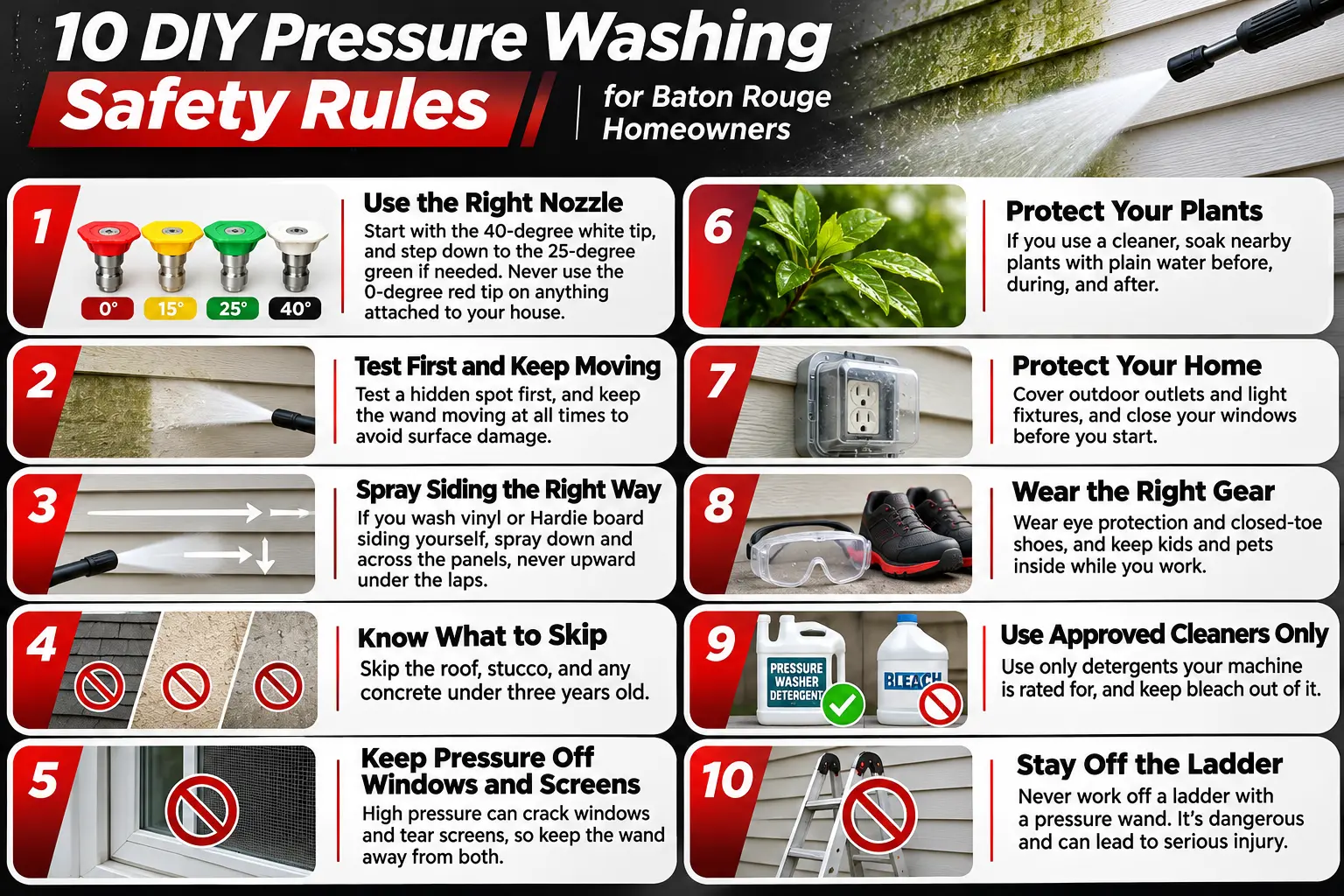
If You’re Going to DIY It Anyway, Do It This Way
What Happens When You Hire Us Instead
Before Your Wash
On Wash Day
Our Guarantees and Limits
If a plant in the wash area shows no new regrowth within 45 days, we replace it. In our first six years, we replaced two rose bushes.
We’re also upfront about limits: we treat oil stains with a degreaser, but we never guarantee they’ll come out completely.
Frequently Asked Questions
Can I put bleach in my pressure washer?
No. Bleach can damage a pressure washer’s pump and internal parts. Check your machine’s manual for the detergents it’s rated to handle.
Is it cheaper to buy a pressure washer than to hire someone every year?
Buying covers the machine only. You also pay for cleaner, gas, and upkeep, and a homeowner unit can’t safely handle the roof or siding at any price. For those surfaces, our annual repeat pricing is the more realistic comparison.
Will pressure washing get oil stains out of my driveway?
Results vary. Oil soaks into concrete, and the longer it sits, the deeper it goes, so a fresh spill is easier to treat than an old one.
Why does my roof still look blotchy after it’s cleaned?
Older shingle roofs that have lost granules can look uneven even when clean. If we notice heavy granule loss before cleaning, we photograph it and send the pictures to you so you know what to expect.
Not Sure Which Side of the Line Your Project Falls On?
If it’s a small patio, go for it. If it’s siding, stucco, a roof, new concrete, or anything you’d need a ladder for, let us take it off your weekend. We measure most homes online, there’s no deposit, and you don’t need to be home. Call us at 225-337-7771.